Sunday, August 13, 2017

Too many drugs? Too few patients?


The article by Gina Kolata in the New York Times ( August 13, 2017) is written from  a perspective that favors drug companies over the patients.    

The current system of clinical trials  started when the average American lifespan was less than 70 years for men, before we knew anything about the molecular basis of cancer, and the slide rule was the most sophisticated, widely available, computational tool. It has always been clear that this system slowed drug availability and, consequently, led to deaths.  

From the patient's (and the caring provider's) perspective anything that improves the chance of more effective therapy is welcome. "Too many drugs" is when there are adequate treatments for all diseases.  "Too few patients " is universal wellness...at reasonable cost. 

The article quotes two Genetech executives (see same day NYT page 7 for the ad for an unrelated Genentech product)  questioning how many immunotherapeutic  agents can be tested.  Genentech's entry in this field,  TECENTRIQ®,,is having trouble proving its worth .  The company  may want to beat its competitors.  The irony of a Merck vice president saying: "How many  PD-1 antibodies does Planet earth need? " is not lost on me.  He might well think that the Merck product, Keytruda, is enough. We do not know that .

The idea of "outstrip[ping] our progress in understanding the basic underlying science"  is incredibly arrogant.  Most of our currently effective  cancer treatments  were developed in the context of models that have been long abandoned.   Our current understanding of immunology and  gene interactions remains primitive and will almost certainly be changed in the future.   Part of refining the model  will depend on the results of treatment with these medicines.  That is the history of medicine. 

In the article the "cost" of genetic testing is quoted at $5000. I find that interesting .  The cost depends on who is paying.  Currently, the materials cost is less than $100.  The amount billed to the insurance company is often about $8500.  If the patient pays directly, it is no more than $3500.

From the  cancer  victim's perspective, the problem is not too many drugs.  The  problem is  the cancer.  The drug companies, the  FDA  and insurance companies are standing between patients and their treatment.  The system needs to change.   

Friday, June 16, 2017

An  applications for computers in medicine

I think about what I do as a physician and a specialist in hematology and oncology,  and how it could be made automatic. If it we're automatic, it would be done more uniformly and rigorously and the calculations would be more reliable.

I believe that machines can do many  things better than I can. Their memories are  perfect,.  Their calculations are exact.

I also believe that, at least at this point, I can add something to the machine. I can be more skeptical. I can understand the motivations of the people who create the input. I can understand the implications of suffering, the feelings of relief and loss.

I look forward to a collaboration with the machine. I do my best to foster it. I have brought the internet to clinical conferences for the last 30 years. Do not forget the sounds of the telephone modem connection in the 1980's.

I would like to see an expanded role for computers in medical decisions. .The  Electronic Medical Record was supposed to help with this integration. It has done a very poor and limited job. Sometimes, it has stood in the way of using the capabilities of computers to help analyze and solve problems. It is very difficult to export  data to a spreadsheet for analysis. This will undoubtedly get better. But the structure of incompatibility among electronic medical records is a violation of one of the main motives of the government that encouraged,  with sizable economic incentives,  their adoption.

In my hematology practice, I am often confronted with the question of the cause and treatment of low blood counts. I have found an analysis of the time course of the fall of such blood counts is useful. Often, a point in time can be identified when the fall began. A pattern can be seen suggesting either a slow, gradual fall or a rapid fall or both phenomena superimposed upon one another. Although these consultations are a welcome source of income for me, I recognize that the algorithm that I use could be made  automatic.  Such an automatic algorithm would help me do this work. Currently, an automatic solution would need to be checked by a human health care provider. Over time, the level of training of that provider might not require subspecialty certification. The primary care provider could do an adequate job of spotting unusual circumstances

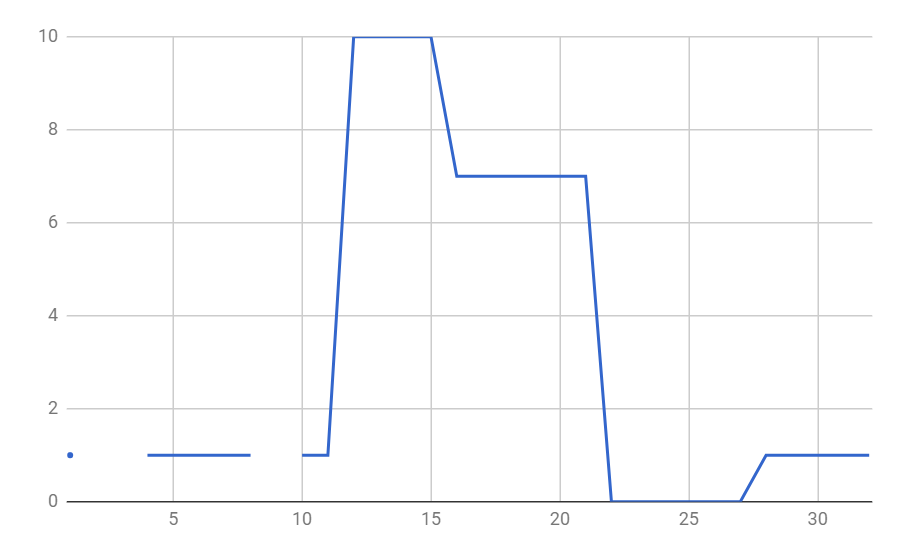
I would like to see the machine identify the time course of variations in laboratory tests and then, automatically, correlate these with variations in treatment. This is not a hard algorithm. Thinking about it was somewhat entertaining. I would do it by going back to the definition of the derivative. One would then look at the slopes of the segments that make up the overall change and identify the more dramatic slopes as times of dramatic change to be correlated with alterations that might be identified in the history, especially medication changes. ( After doing the calculations, I realized that this was probably  the beginning of Newton’s method of difference,  the origin of calculus that I had recently read about in James Gleick’s biography of Isaac Newton.)  

This approach could also be used to monitor whether interventions are effective. Improvements could be correlated with interventions directed at those parameters.

Such an algorithm does not replace the human It simply helps her. I think we need it.

Model curve

"derivative" curve identifying days of greater and lesser change

Sunday, January 29, 2017

Understanding and Practice:

Understanding and Practice:

How deeply do I understand the bases for my medical decisions? What constitutes practical understanding?

I practice a high stakes type of medicine: hematology and oncology.  My patients have life threatening diseases.   Patients expect a highly educated, highly informed opinion about how to proceed.  They believe  that I understand the medical research  that forms the basis of the treatment plans.  What does it mean: "to understand"?

Understand is a word that consists of two components:  under and stand, both easily  comprehended English words. I can imagine this combination  of words to mean having a relationship with the subject that  does  not crush me, I can stand under the image and look at it objectively and agree.  I can bring supporting ideas to bear on the issue, see the basis of the conclusion. 

To understand disease and treatment  has a variety of its own  meanings.  There is a  quantitative aspect to understanding, it can be broad or narrow, superficial or deep. Using these terms to describe understanding reflects its architectural nature.  Understanding is a structure.  If it claims to be  tall its foundation must be very deep, it can easily topple,  a  poorly supported claim of understanding is a very insecure structure.

Within medicine, within oncology, understanding means different things. Evaluating microscopic images requires a set of cognitive skills that is quite different from evaluating the statistics of clinical trials outcome data.  The  interpretation of large data sets that describe  outcomes is  very separate from that molecular biology that describes the mechanisms of disease and recovery. Once  a particular type of interpretation is relegated to an expert, without review by the deciding physician, it become religious scientism, faith in a vaguely understood process, believed on the basis of a report there is an unrecognized underpinning of pure faith.   It is the intelligent  integration of the various facets of information that constitutes understanding.  Understanding requires skepticism and self criticism.

The practice of medicine requires sufficient understanding to know when to use a given therapy and when  not to.  It implies a knowledge of how to administer the treatment and how to deal with its consequences.  Unfortunately, in our rapidly changing world, depth has become optional.

Often, the understanding is quite superficial.  It consists of  recognizing a  pattern that identifies a disease, reviewing sets of  guidelines or  published recommendations;  deciding  among the various alternatives; beginning   treatment; and dealing with consequences.  This pattern of behavior  is not simple and requires a high degree of education and intelligence.  But it  is not what I call understanding. 

In our era,we have come to question the  value of deeper understanding . The big data approach suggest that the  analysis of a large enough data set  will yield a better set of predictions  than a model  of disease and treatment based,  theoretical "understanding" of (an imagined)  underlying mechanism. There is undoubtedly a role for this kind of agnostic knowledge.  But, an approach that denies any level of mechanistic  understanding may fail to   identify  the heterogeneity of the data set and  obscure important information. In the large dataset we are often naming a number of diverse  entities the same diagnosis.  We now recognize some of these differences and separate the abnormalities that will reliably respond to  their special treatments, but this process of differentiating molecular diagnoses is in its infancy.  It is only begining to penetrate clinical trials.

 What we currently call a diagnosis usually does not correspond to a single molecular entity.  A  diagnosis  today is  a combination of a clinical history, physical and radilogic findings, a particular microscopic appearance with certain stains,  an aberrant  collection of  surface molecules, and/or a  set of mutations  in critical genes. Whe the diagnostic lable is attached , there is often no recognition of the methods used to arrive at the diagnosis. Sometimes one set of methods is applied, sometimes another

The important,  practical goal  is the  identification of a  distinguishing mark that directs therapy, the piece of information that will lead to cure.   Finding that is something I can support.  When I have that piece of information, in a practical sense,  I understand.

Sunday, December 11, 2016


Computer Aided Oncology Conference


Every week I go to a few conferences in which cancer cases are discussed.  Oncology, the branch of medicine that treats cancer, is a very active area.  Developments are reported daily.  The rate of clinically important discovery is accelerating.  

I have a good memory, evidenced by my performance in medical school  and  National Boards exams.   But my computer remembers much better than I can.  It never forgets anything. My computer can access the world's medical literature in seconds.  It can translate papers from Chinese.  It can give me the most recently updated recommendations from the NCCN, or the BC Cancer Agency, or the UpToDate  online textbook instantly.  That is why I come to conference armed with my computer linked into the internet.   

 The continuous improvement in computer intellectual power is demonstrated by their relentless ascendancy in high level games.  Chess, Jeopardy and Go are contests in which  complex decision processes are tested and demonstrated.   In 1997, Garry Kasparov lost the world chess champion to a computer,  IBM’s Deep Blue.   It was predictable that the machine would, eventually, win.  IBM's Watson became the greatest of Jeopardy champions. Google’s AlphaGo  is sweeping the Go world.  All of these games, whose masters have extraordinary talents and abilities, are yielding to the machine.  The machine has qualities that no human will ever be able to match... unassisted. 

The machine never forgets. The machine can search its memory, most of the world's knowledge, with lightning rapidity.  It can carry out algorithms at near light speed. The puny, slow moving human memory is no match

But humans have qualities that the machine cannot (yet) replicate.  The human has sensitivities, shared in a multifaceted and spectral way, with other humans.  There are ways in which we understand each other that a silicon processor cannot.  It could, possibly, be programmed to mimic the human responses to emotion, but it cannot feel empathy. 
When I bring my computer to conference, I add to the machine.  I tell it what to look up.  I define the search parameters.  Having done this for more than 25 years, I can do it rapidly and well.  It is an art that incorporates a level of speculation about how biological processes might be related.  It also involves a (reasonable) expectation that someone else has had the same question and it has been written about.  
I then decide which articles are truly relevant and estimate the validity of the information.  Even a human brain can do all this in less than two minutes.  I think it works out well.  That is why I continue to do it and encourage others to try it, and improve upon it. 
 The machine is spectacular in the things it can do.  The doctor adds human qualities and direction to that instantly accessible, vast, and reliable knowledge base.  No person can beat the machine in its tasks, but the combination of the human and the machine remains (for the foreseeable future) the best solution, better than the machine alone. 
The presentation of the patient's case at conference and sharing of experiences and opinion  is critically important.  It forces an organized and clear presentation. All the data (pathology, imaging, etc.) is open for inspection and scrutiny. Sometimes, carefully considered human analysis  prevails over all the data.  
  Better data can help create better opinions.
  Let’s improve. 


Sunday, March 27, 2016

Tortoise and Hare

Tortoise and Hare

The profound truth of Aesop’s favorable can be seen in oncology.

We all remember the story:  the tortoise and the hare agreed to a  race.  There is no doubt about who is the faster.  But as a consequence of his early lead, the hare falls asleep and loses the race.

The same phenomenon happens in the treatment of cancer.  There are often breakthroughs, instances of rapid progress in the understanding and treatment of various malignancies.  Industries develop around these advances.  The advances become standard practice.  But the adoption of these new treatments can stand in the way of developing even better treatments.

Checkpoint inhibitor therapy, medicines that block the immune system turn off valve, allowing a more effective immune-driven attack on the cancer, was first developed and approved in melanoma.  There was really no effective treatment for advanced melanoma 10 years ago.  It was an l oncologic tortoise.  Checkpoint inhibitor therapy is not specific to any particular cancer.  There is no clear relationship to melanoma.  But there was so little to offer melanoma that trials could quickly proceed followed by prompt approval of these medicines.

Now checkpoint inhibitors are being studied in a variety of cancers.  They are already approved for squamous cell lung cancer and commonly used for metastatic renal cancer.  These are two other cancers  for which therapeutic options are limited.  But this type of treatment has no clear relationship to the cancer histology.

In cancers that have an array of somewhat more effective treatments, the introduction of checkpoint inhibitor therapy has been much slower.  The tortoise that has become the hare,  cannot enter the race  because of previous rapid advances.

The use of next generation sequencing for the classification of hematologic malignancies is also a case of limited advances blocking the introduction of deeper techniques.  Prior to the introduction of relatively rapid DNA sequencing techniques, hematologic malignancies ( leukemias and lymphomas) were the most extensively molecularly  characterized malignancies, Chromosomal rearrangements defined diseases and directed therapy.  Clonality, a fundamental property of malignancy,  was easily and standardly determined.  Disease could be followed on a molecular level.

However, heterogeneity remained.  Rarely, patients who had a very high probability of excellent response could be identified on the basis of these chromosomal, FISH and limited PCR tests.  But the details remained mysterious and thus the response to treatment remained unpredictable

The introduction of next generation sequencing for the characterization of hematologic malignancies has been slower than from many solid tumors.  The advances made with older molecular techniques have blocked the introduction of the more detailed and extensive analysis now available.  On a molecular level, hematologic malignancies have been asleep

I think there is value in this awareness.  The extreme sub-specialization In oncology has limited the diffusion of advances from one field to another.  The economic arrangement of the healthcare system favors maintaining diagnosis and treatment on a plateau of adequacy It should be helping advanced medicine to increasing excellence.

Sunday, February 28, 2016

The Box

Lymphoma Rounds: In the box

Should doctors think in  the box?  Sure, if the box works, If the therapy is effective, if the criteria for diagnosis define an entity for which the treatment is successful, barring a complicating factor, then one should follow the guidelines, the textbook.  .  One should be sure about identifying the problem and choose the best solution and do it.There are situations in which  this scenario applies: many infections, most Hodgkin's Lymphomas, many testicular cancers. Once the diagnosis is secured, the exceptions ruled out, and the patient tolerance assured, following the formula will yield the desired outcome.

I went to lymphoma rounds.  The first case was a case of lymphomatoid granulomatosis. This is an unusual diagnosis.  The case was more unusual because of CNS signs and symptoms.  The case was presented by a fellow and discussed by a neuro-oncologist. That meant that the neurological aspects o the case were made  primary. 

The relationship to Epstein-Barr virus in this lymphoma was clearly stated and recognized. We had all learned the pathophysiology of EBV disease: cells are transformed, changed by EBV into cells that share many qualities with malignant cancer cells.  They are immortal, The program for cell death is turned off..They reproduce out of control.

The acute disease, mononucleosis, usually comes to a good conclusion withe the patient's T cell based immunity victorious.  But there are EBV driven lymphomas that are not self limited, lymphomas that  do not improve without strong, chemotherapeutic intervention.  These include various lymphomas in the immunocomprimised. Patients with  (uncontrolled) HIV disease can get  aggressive lymphomas, including CNS lymphomas,  from EBV.  One of the most aggressive of all lymphomas, Burkitts lymphoma, in its classical form, is an EBV driven disease.  Patients who have had organ transplants and take immunosuppression  can get less aggressive  lymphomas like PTLD, a lymphoma that often responds to changes in immunosuppresion.  EBV disease often has an immunological basis

The case was discussed in terms of published treatment outcomes, the standard therapy was CHOP, all purpose lymphoma therapy.  Some mention was made of interferon, which seemed to succeed in some cases, but was not used in this case. 

I asked if the this entity could be divided into different groups based upon the immunologic status of the patient,  and the nature of the cells identified in the biopsies.  After a long silence, I said that I did not expect and answer to the question.  (This patient's immunologic status had not been investigated.) 

The true meaning of the question involved the approach to such diseases.    We live in an era of instant access to millions of research findings.  Almost anything you can think of has been written about,  What is written is not necessarily good, and may even be misleading, but should not be ignored. 

When a disease is outside the of the set of the clearly curable with standard approaches, the consideration should include an approach that incorporates our beliefs about pathophysiology.  Such an approach can lead to other pathways for diagnosis, treatment and prognosis. 

I think that there is always an immunological aspect to EBV disease. The immunologic aspect has implications for HIV related lymphoma, encouraging anti retrovirals and the reconstitution of CD4 mediated immunity.  We exploit it in PTLD by adjusting immunosuppression ( sometimes  along with Rituxan)  Even when there is central nervous system involvement, simply reducing immunosuppression can be sufficient for remission in PTLD.

I do not completely trust our (current) understanding of pathophysiology.  It will probably change with the acquisition of further knowledge, but I am not prepared to take it out of the picture, 

Hypotheses about the nature of the patient's disease can be lifesaving.  They can also be terribly misleading.  Interpretation requires great care and open discussion 


Friday, November 27, 2015

The Martian: How much is a person worth?

The Martian: How much is a person worth?

Recently,  I saw The Martian, a movie about a man accidentally abandoned on Mars.  The movie is about the struggle for survival, the marshaling of forces to allow the survival of that one man,  the sacrifice of  compatriots and the politics of rescue .  

Cancer patients, and the people who care for them, can feel like they are abandoned on Mars. The feelings elicited by this movie are similar to those we, who care for cancer patient patients feel. When do we call the situation hopeless?  When do we give up?  How much can we put into the effort for one patient?  How much can we spend?

In the movie there is no limit. Billions of dollars are spent,  scores  of people work without rest, people give up years, in the prime of their lives, to attempt to rescue a single man.  In our real, medical world the money, the time, the energy are all limited,  The resources are shared by thousands of patients. This places every part of the medical system in the position of distributing a limited, precious resource.  The doctor must balance the chance of benefiting the patient against the cost to the system, which could mean denying another patient an equal or better chance.  Doctors differ in their approach to this problem.


How can we do any less than our best?   Our efforts are not like those in the movie.  They are not as good as they should be.. The basis for saving the Martian was adoption of a nonstandard strategy, a strategy that would work, in theory, but was not a usual approach.  A methodology that involved unanticipated expense and sacrifice.

Currently, the pressure to follow standard procedures is almost overwhelming.  Deviation from such standards  risks the label of malpractice.  Obtaining insurance coverage for a treatment that is not recommended in guidelines, or for a problem that deviates from the FDA  approval parameters is a Herculean task - and getting harder.  .


Knowledge and Resources are always limited. The Martian was rescued, he beat  the odds. It is very expensive and difficult to take on the odds... sometimes it works.